
Running is one of the purest expressions of health. Whether you’re training for a 5K, enjoying weekend Park Runs, building mileage for a marathon, or simply heading out to clear your head, you run to strengthen your heart and extend your longevity.
Yet there is an uncomfortable irony.
The very environment that delivers those benefits open roads, coastal paths, parks, hills and mountains also increases exposure to ultraviolet (UV) radiation, the primary cause of skin cancer.
Skin cancer is the most common cancer worldwide. And runners, by definition, accumulate hours outdoors.
Even on overcast days, up to 80% of UV radiation still reaches the skin. Shade from tree lined routes provides inconsistent protection. And altitude increases UV exposure by roughly 10% for every 300 meters gained[1].
This isn’t about one bad sunburn. It’s about cumulative damage measured in years and decades.
Research shows professional outdoor athletes can receive more than 30 times the recommended daily limit of UV exposure. While recreational runners may not reach that extreme, the pattern is similar: frequent, repeated exposure that quietly adds up.
In clinic, we see the consequences of this pattern — often in people who consider themselves extremely health conscious.
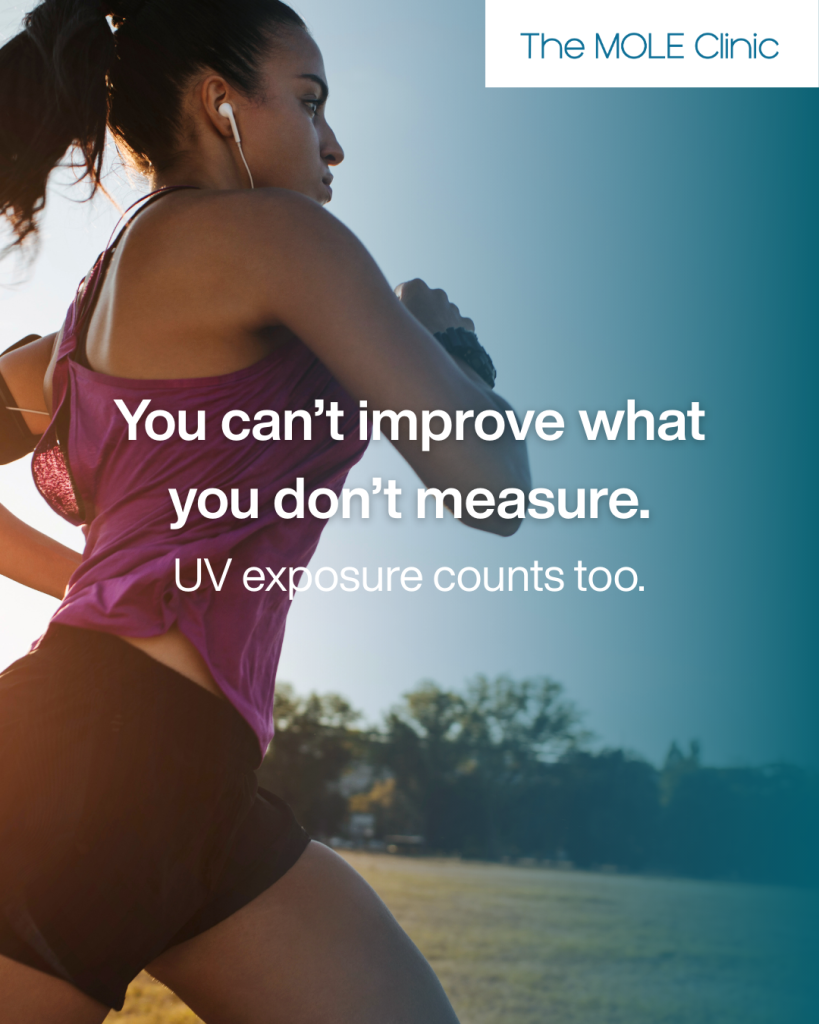
1. Sweat: Your Cooling System — and a UV Multiplier[2]
Sweat cools you. But it also changes how UV interacts with your skin.
When the outer layer of your skin becomes hydrated during exercise, it alters how light penetrates. Studies show sweating increases photosensitivity, allowing UV radiation to reach deeper layers of the skin.
For runners logging long, sweaty sessions, this makes high-quality, water-resistant, broad-spectrum SPF essential — not optional.
2. SPF vs UPF: The Fabric Advantage
Sunscreen matters. But clothing is often your most reliable protection.
SPF protects mainly against UVB and relies on correct application.
UPF 50+ fabric blocks up to 98% of both UVA and UVB — and doesn’t wear off mid-run.
Smart additions to your kit:
- Wide-brim hats (protect ears and neck — common sites for Squamous Cell Carcinoma)
- UPF 50+ technical tops
- UV arm sleeves
- UV400 sunglasses
Think of UPF as “set and forget” protection.
3. The Sunscreen Myth: “It Makes Me Overheat”[3]
Clinical research shows modern, water-resistant sunscreens do not impair thermoregulation or sweat evaporation during exercise.
Performance and protection are not mutually exclusive.
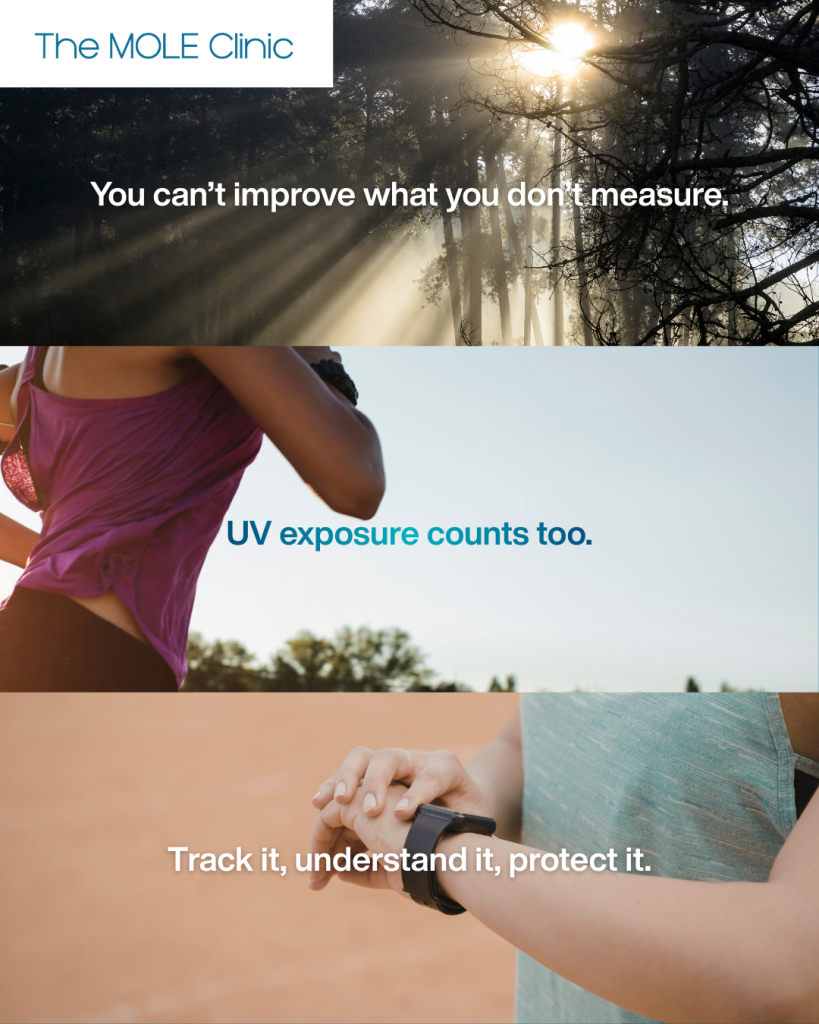
4. The Cumulative Hours Trap[4]
The biggest risk factor for runners isn’t race day.
It’s:
- Runners who train or compete outdoors for 40 or more hours per week are at a significantly higher risk for malignant melanoma[5]
- Weekend long runs
- Summer mileage blocks
- Years of outdoor consistency
In clinic, we frequently see this pattern.
“We regularly see runners — particularly those in their 40s and 50s — presenting with Basal Cell Carcinomas on sun-exposed areas such as the nose, ears, shoulders and calves,” says Dawn Lisa, Lead Skin Cancer Nurse at The Mole Clinic. “The positive news is that most are detected early and are very treatable. However, a common theme we hear is that many never viewed their routine training runs as meaningful sun exposure.”
Basal Cell Carcinoma (BCC) is the most common form of skin cancer. It rarely spreads, but it can become locally destructive if ignored. The earlier it’s identified, the simpler the treatment.
Melanoma is the most serious type of skin cancer, arising from pigment-producing cells (melanocytes) due to UV damage. It can spread and affect your life expectancy.
That’s why screening matters.
Prevention Is Only Half the Equation
Self-checks using the ABCDE rule to look for melanoma are important:
- Asymmetry
- Border irregularity
- Color variation
- Diameter >6mm
- Evolving
But self examination alone is not enough.
For runners who train outdoors regularly, an annual full body professional skin check should be routine , just like a dental check-up or eye test.
Early stage skin cancers are significantly easier to treat. When detected early, outcomes are excellent and interventions are often minor.
Clinics that specialise in skin cancer detection frequently identify cancers before patients themselves notice anything concerning particularly in hard to see areas like the back, calves, and behind the ears.
Redefining the Running Ritual
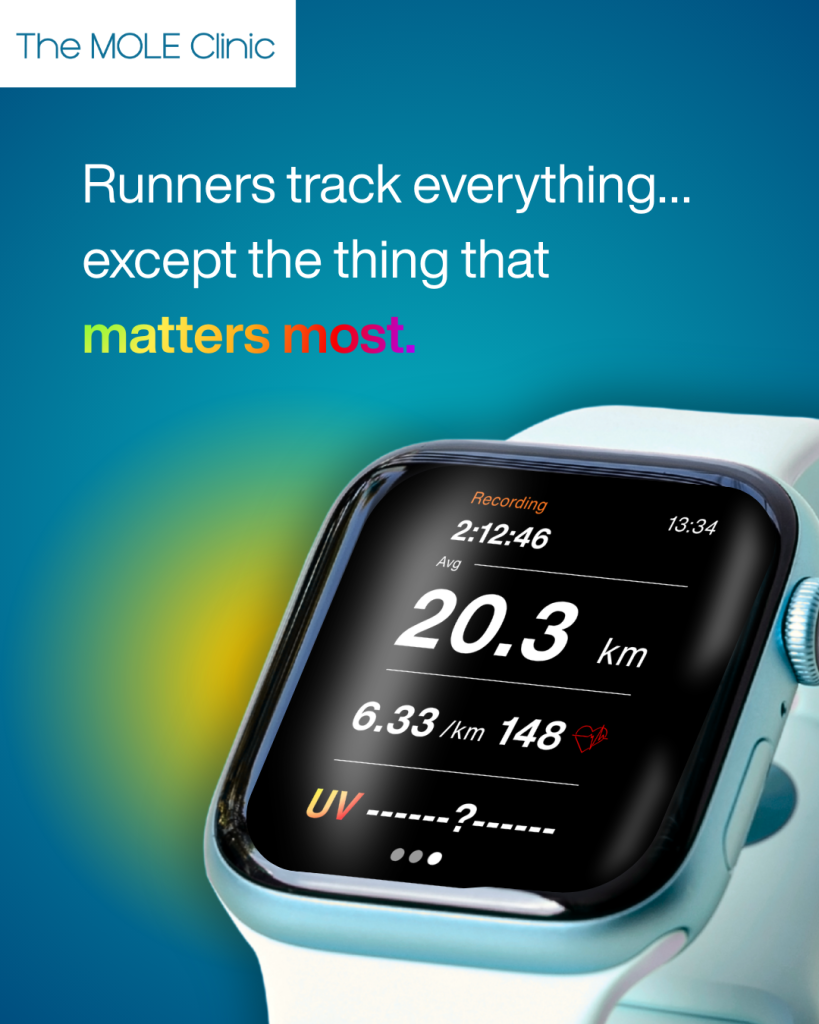
Runners are disciplined. You track splits, heart rate, and hydration. You invest in shoes and recovery tools.
Add to that:
- Broad spectrum SPF 40 -50+
- UPF 50+ technical gear
- Wide-brim protection
- And an annual professional skin check
Protecting your skin doesn’t detract from your performance. It protects your ability to keep running for decades.
You train your heart for longevity.
Make sure your skin is part of the plan.
[1] Moehrle, M. (2008). Outdoor sports and skin cancer. Clinical Dermatology, 26(1), 12-
[2] Moehrle, M. (2008). Outdoor sports and skin cancer. Clinical Dermatology, 26(1), 12-
[3] Ou-Yang, H., et al. (2018). Sunscreen formulations do not interfere with sweat cooling during exercise. International Journal of Cosmetic Science, 40(1), 87-92.
[4] Christoph, S., et al. (2016). Ultraviolet radiation protection and skin cancer awareness in recreational athletes: a survey among participants in a running event. Swiss Medical Weekly, 146:w14297.
[5] Ambros-Rudolph, C. M., Hofmann-Wellenhof, R., Richtig, E., Müller-Fürstner, M., Soyer, H. P., & Kerl, H. (2006). Malignant melanoma in marathon runners. Archives of Dermatology, 142(11), 1471-1474