
A patient sits down and says, "Could you have a look at this mole?"
You have a few minutes. You may or may not have a dermatoscope to hand. And you have three options: reassure, treat, or refer.
It is one of the most consequential judgement calls in a routine primary care appointment, and one of the least supported by training. Most GPs qualify with very little dermatology teaching and almost no formal dermoscopy. Yet skin complaints account for a substantial share of consultations, and skin cancer is the most common cancer in the UK.
The numbers behind the pressure
A UK primary care analysis published in BMC Primary Care put a figure on the problem. Of urgent two week wait skin cancer referrals made by GPs, only 6.5% ended with a confirmed diagnosis of skin cancer. The other 93.5% were benign.
Think about what that means at the scale of the NHS. For every patient with a skin cancer picked up through the urgent pathway, more than fourteen others go through the same two week wait for a seborrhoeic keratosis, a dermatofibroma or a benign naevus. Each one waits anxiously. Each one takes a slot that a patient with an early melanoma needed. And dermatology waiting lists remain among the longest in the NHS.
None of this is a criticism of GPs. Faced with uncertainty and no tools, referring is the safe and responsible choice. The problem is the uncertainty, and that is fixable.
Two ways in which we can improve
The first is the one everyone worries about: missing an early melanoma. A lesion that looks innocent, gets reassured, and comes back a year later when the skin cancer is more advanced and harder to treat.
The second is the 93.5% of patient referred with lesions that turn out to be non-malignant: many of these lesions could have been diagnosed as benign by a trained eye and reassured on the spot without need for a referral
Dermoscopy addresses both. With a dermatoscope and a handful of pattern recognition skills, a GP can confidently screen out a large proportion of benign lesions at the first appointment and recognise the features that warrant urgent referral. It is not a specialist skill. It is a learnable one, and it is the single intervention most likely to move that 6.5% in the right direction.
Why we are giving it away
The MOLE Clinic exists to find skin cancer early. Our clinicians look at tens of thousands of lesions a year, and over time we have accumulated a great deal of practical knowledge about what matters at the point of first contact.
Over the past year, GPs have asked us repeatedly for help with CPD in dermoscopy and early skin cancer detection. Most dermoscopy courses come with a fee and a day out of practice, which puts them out of reach for many. We concluded that the most useful thing we could do was to make good training free and easy to attend.
So we set up The Dermoscopy Foundation.
Free training for healthcare professionals
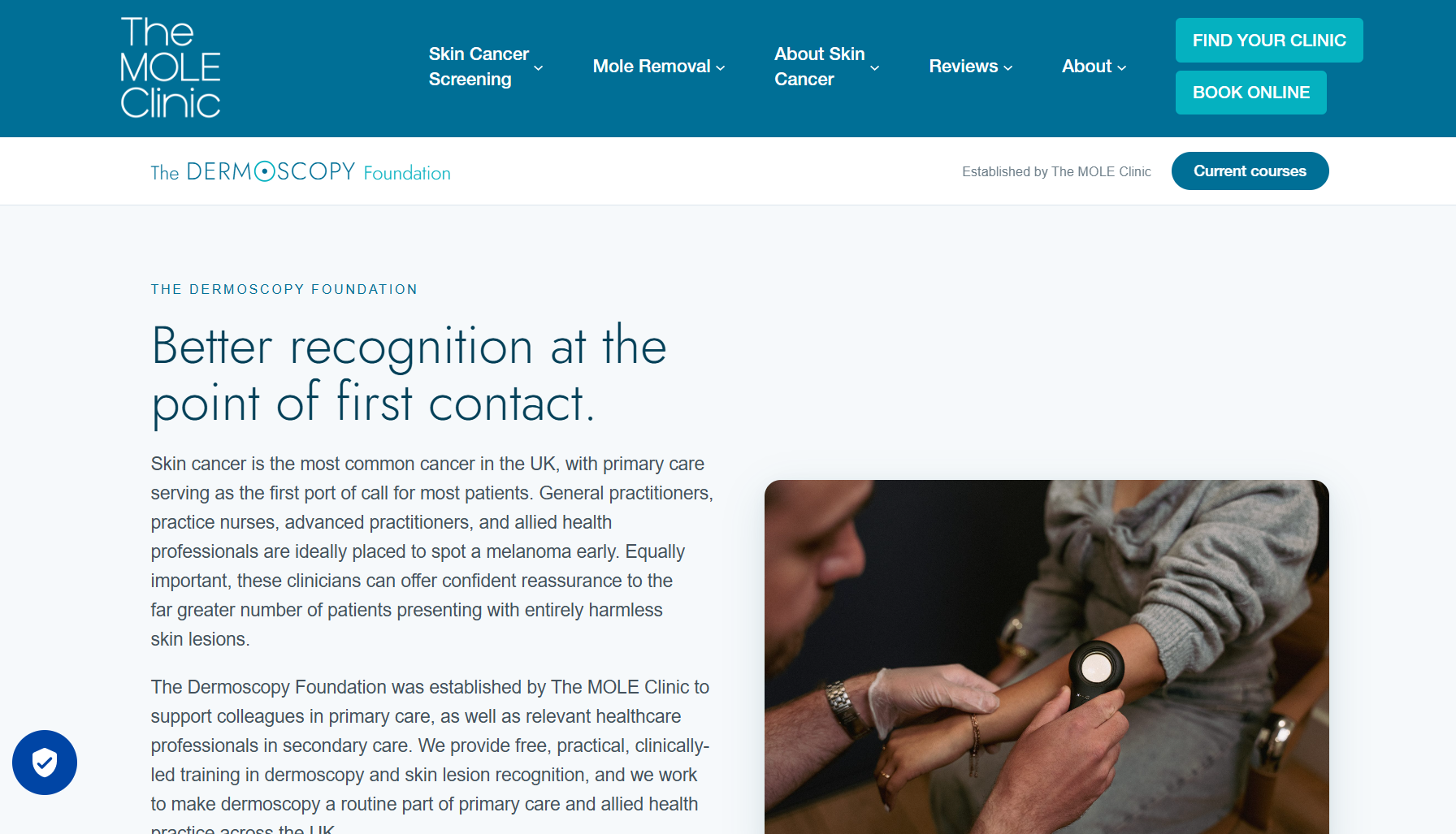
The Dermoscopy Foundation provides free training in dermoscopy and skin lesion recognition, led by Dr Tim Cunliffe. Tim is a GP with Extended Role in Dermatology and Skin Surgery, Skin Cancer Lead at South Tees Hospitals NHS Foundation Trust, author of the Primary Care Dermatology Society website and former Executive Chair of the PCDS. He has spent much of his career teaching exactly this.
Training topics include:
- The clinical features that separate benign from malignant lesions
- The dermoscopic features that let you confidently screen out common benign lesions
- Managing precancerous lesions such as actinic keratoses
- Practical tips on teledermoscopy
- Time for your questions
The training is designed for GPs but is just as relevant to practice nurses, ANPs and anyone else in the team who looks at skin. Most GPs self-certify one CPD credit per hour.
What comes next
We are planning a full day in-person programme for 2027 and a waiting list is open for anyone who wants to hear about it. We already run a skin cancer awareness session for physiotherapists, whose first graduates completed in September.
If you see patients with skin complaints, join the 2027 programme waiting list and sign up for future training updates.
If you run a practice, PCN, LMC or Training Hub and would like to bring a session to your area, we would like to hear from you.
Earlier diagnosis starts in the consulting room. We would like to help.
Source: BMC Primary Care (2022), two week wait skin cancer referral outcomes in UK primary care.