
Dr David Veitch, Medical Director at The MOLE Clinic, breaks down why golfers face a significantly higher risk of skin cancer — and what every player should be doing to stay protected.
For many, golf is a relaxing way to spend time outdoors. But while it’s excellent for physical and mental wellbeing, it also comes with a hidden health risk: prolonged exposure to ultraviolet (UV) radiation.
“Golfers are what we consider a high-risk group for skin cancer,” explains Dr Veitch. “It’s not just occasional sun exposure — it’s the cumulative effect of hours spent outdoors, often during peak UV times, over many years.”
Here’s why that matters.
Why Are Golfers at Higher Risk?
Extended Exposure During Peak UV Hours
A typical round of golf lasts between four and six hours — much of it in direct sunlight. Most rounds take place between 10am and 4pm, when UV radiation levels are at their highest.
“That’s the most dangerous window of the day for UV damage,” says Dr Veitch. “And golfers are often exposed for the entirety of it.”
Extreme Cumulative UV Radiation
The level of exposure golfers experience is substantial:
- Professional golfers may receive up to 217 times the annual UV radiation required to cause sunburn.
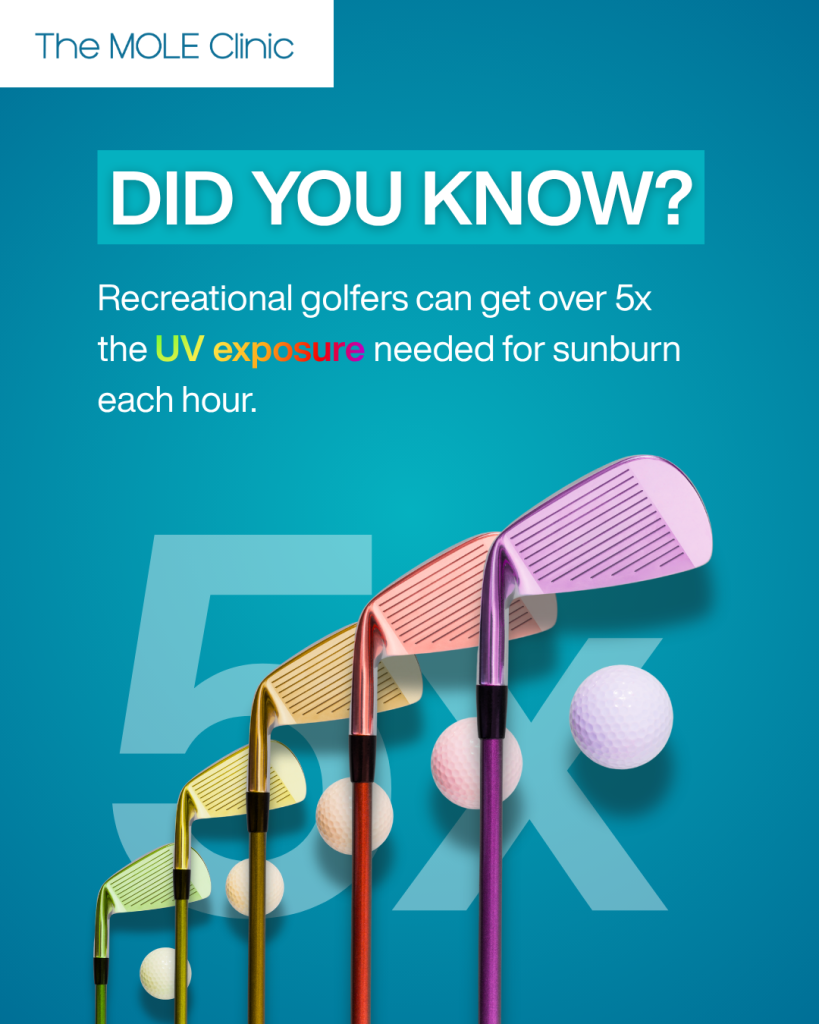
- Even recreational golfers can receive over five times the UV exposure needed for sunburn per hour on the course.
“Skin damage is cumulative,” Dr Veitch explains. “It’s not just about burning — it’s about long-term DNA damage that increases your lifetime risk of melanoma and other skin cancers.”
The “Grip Problem” and Sunscreen Avoidance
Many golfers avoid sunscreen because they worry about greasy hands affecting their grip.
“We hear this frequently,” says Dr Veitch. “But skipping sunscreen because of performance concerns can significantly increase risk.”
Even those who apply sunscreen often forget to reapply every two hours, which is essential for effective protection — especially during long rounds.
Inadequate Apparel Coverage
While golf clothing has evolved, not all garments provide meaningful UV protection.
- Standard clothing may offer an SPF of only around 7.
- Many styles prioritise comfort and appearance over protection.
- The neck, ears, arms and hands are frequently exposed.
“If clothing isn’t specifically labelled with a UPF rating, you shouldn’t assume it’s protective,” advises Dr Veitch.
Environmental and Demographic Factors
Additional factors increase risk further:
- High altitude courses intensify UV exposure.
- UV rays penetrate cloud cover — overcast does not mean safe.
- Men over 40 — a key golfing demographic — experience high cumulative UV exposure and rising melanoma mortality rates.
“All of these factors combine to make golfers a particularly vulnerable group,” says Dr Veitch.
How to Protect Yourself on the Course
The good news? Skin cancer is largely preventable.
Use Sunscreen Properly
- Apply a broad-spectrum SPF 30–50 sunscreen before dressing.
- Use approximately a shot glass amount for full body coverage.
- Reapply every two to three hours, especially if sweating.
Solving the “Grip Problem”
- Use a sunscreen stick for the face, neck and arms.
- Choose oil-free or water-resistant formulas that dry matte.
- Apply to hands early so they absorb fully before play.
“Modern sunscreens are far more wearable than people realise,” Dr Veitch notes. “There’s no reason protection should compromise performance.”
Protect High-Risk Areas
Pay particular attention to:
- The back of the neck (often the highest UV-exposed area)
- Ears
- Scalp (especially thinning hair)
- Hands
- Lower legs
Choose Proper Protective Apparel
- Wear UPF 50-rated clothing where possible.
- Opt for a wide-brimmed hat (at least 3 inches) — baseball caps leave ears and neck exposed.
- Use UV-blocking sunglasses (99–100% UVA/UVB protection) to protect both the eyes and eyelid skin.

Adopt Smarter On-Course Habits
- Seek shade whenever possible.
- Use a golf umbrella or shaded cart.
- Be cautious on cloudy days.
- Take extra care at high altitudes.
- When driving, keep windows closed — side windows can allow significant UVA exposure.
Early Detection Is Critical
Even with good protection, regular skin checks are essential.
“We recommend annual head-to-toe skin examinations for golfers,” says Dr Veitch. “When detected early, nearly 99% of skin cancers are curable.”
Know the ABCDE Signs of Melanoma
Check your skin regularly and look for:
- A – Asymmetry
- B – Border irregularity
- C – Colour variation
- D – Diameter larger than 6mm
- E – Evolving size, shape or colour
“If something changes, grows, darkens or bleeds — get it checked,” Dr Veitch advises.
The Bottom Line
Golf is a fantastic sport — but it comes with prolonged UV exposure that significantly increases skin cancer risk.
With the right sunscreen, protective clothing, smart habits and annual skin checks, golfers can dramatically reduce that risk — and continue enjoying the game safely for years to come.
If you’re a regular golfer and haven’t had a recent skin check, it may be time to book one
Book a Professional Skin Check
At The MOLE Clinic, we offer comprehensive Full Body Skin Checks and advanced Mole Mapping to help detect skin cancer at the earliest possible stage.
Our Full Body Skin Checks involve a thorough, head-to-toe examination performed by experienced skin cancer clinicians, using dermoscopy to assess any suspicious lesions in detail.
For patients with multiple moles or those at higher risk — including regular golfers — Mole Mapping provides a more advanced level of monitoring. This technology captures high-resolution images of your skin and tracks changes over time, allowing for early detection of subtle developments that may not be visible to the naked eye.
Early detection saves lives. If you spend long hours on the golf course — or simply want peace of mind — booking a professional skin check is one of the most important steps you can take to protect your health.